Chamonix, France Son gave me a wonderful Christmas present. A night in a mountain hut in Chamonix and a hike on top of the world. I couldn't have been happier. Probably the best gift I have ever received. Son currently lives in Chamonix, for he is a digital nomad. So he can live where he pleases. I wont say 'he is lucky', for he made it happen. All the best realised dreams come from personal endeavor. That much I do know. The chosen hike involved a significant climb. I was worried that I wasn't fit enough. Son is not massively tolerant of slow people. He runs up and down mountains every week. So for the last five months I have been doggedly trying to get 'mountain ready'. Following an exercise programme that seemed to involve one step back for every two steps forward I experienced different body pains after different exercises. Trying to balance progress with what my body would tolerate. Hiking up hills with a heavy rucksack on my back. Leg, arm and core exercises in the living room. I made progress, but altitude was something that I couldn't prepare for. I did my best.  And so I arrived in Chamonix. I nearly missed my flight due to unplanned underground delays and a 'body' on the line. My hiking poles didn't make the journey in their special tube. Hiking poles are too 'dangerous' to take on board as carry on. It was not an easy start. But I arrived happily in the mountains. And the sun was shining. Delicate clouds were drifting over Mont Blanc and the Glacier Bossons.  Mont Blanc and the Glacier Bossons I had a day to myself before the big adventure. Time to think about all the kit that I had gathered in my preparations for the hike and our night up the mountain. Sharing a room with strangers was the part that I was least looking forward to. I practised using my foam earplugs..... For the first time in my life I had gathered together almost all of the recommended essential items for hiking in the mountains, plus a couple of luxury items that would permit me a shower if I felt the need. I didn't have a knife..... nor was I sure what I would use one for. Son had a knife. I had a bandage and some plasters...... We were fully equipped. Time for a hike and a wander around town. Chamonix is a trail running mecca. While I was there it was a weekend of marathons; 90km, 42km and 23km, all involving many thousands of metres ascent and descent. The Mont-Blanc Marathon. Marathons for tough people. The shops are full of trail running gear. To me it was a whole new world. Most appealing are the shoes..... joyfully coloured and light. No matter that they will be splattered with mud as soon as they go into action. And then there are running vests with double water bottles that squish down as you drink, superlight clothes and anoraks, and superlight folding hiking poles. It is a world of specialised gear. One that I do not belong to. For I am just a humble hiker, with a normal, non collapsing water bottle and normal hiking poles. I soaked it all up. And treated myself to a superlight sun hat.  trail running footwear  mountain marathon runners' kit I practised hiking with my kit. My hiking poles were delivered by courier by mid morning on day two so I was ready for action. I hiked on the opposite side of the valley, looking across to the location for our big hike the following day. The remains of the winter snow were rain stained and dirty looking. Shorts and t-shirts were the order of the day. It was hot. Ice-creams were selling like hot cakes in town. The view across the valley was spectacular. I wondered why I was carrying so many clothes. I probably wasn't going to need my warm emergency layers.   Chamonix from Petit Balcon Sud. And then the big day came. After watching and cheering folk arriving back to the finish line of the 90km marathon our time had come. Except that it didn't. One hour before we were due to ascend the mountain using the Aiguille du Midi chairlift, the lifts closed down for the day. High winds and a possible storm had arrived. The top of the mountains disappeared into the clouds, and we had to cancel our outing. We looked up to see the Refuge du Plan de l'aiguille sitting tormentingly out of reach. So near and yet so far. All that preparation and no way to get up the mountain to the starting point for our 'adventure'.  Refuge du plan de l'aiguille just to the left of the chairlift pylons. And yet, strangely, it didn't matter. Not in the grand scheme of things. I really didn't mind. Most of my enjoyment had already been had; in the anticipation and preparation. I was in the mountains with my son. We didn't have to sleep with snoring strangers, and we were able to share a delicious cheese fondue with his friends. And the following morning we approached the mountain by a different route, still cloud shrouded. We visited the Mer du Glace glacier with its ice caves carved out of the sea of ice.  protective sheeting against sunlight on the Mer du Glace glacier. Having visited the ice caves we climbed up the stony path on the hike that we should have done, in the opposite direction, until we were immersed in cloud. It was grey, damp, steep and rocky. Around us were wild azaleas, pink and bright. I never got to see the spectacular views across the valley, or to see Mont Blanc from the Aiguille du Midi. But that is the nature of adventures. We cannot outsmart the weather, and not all goals are achievable. I tried to imagine the disappointment of going to Everest and not making the summit. Statistics tell me that of those who travelled to Everest Base camp in recent years about two thirds reached the summit. Which means that one in three people do not achieve their goal. I was surprised to discover that women are more likely to succeed. Between 2006 and 2019 0.5% of women and 1.1% of men died during the Everest summit ascent/descent. It is a risky business. Obviously my adventure was seriously tame in the grand scheme of things. The weather won on this occasion, but I am still alive, and the mountain will still be there on my next visit. I can try again. Meanwhile son will continue to set himself big challenges, and I will continue to be happy to set myself smaller ones. Having goals and setting oneself challenges is one of the keys to happiness. as discussed in the very last interview on BBC Sounds by Michael Moseley with psychologist Paul Bloom on 'How to Live a Good Life'. I absolutely agree; I have had so much pleasure preparing for this mini adventure. It is the journey, not the destination that matters. And now I am busy thinking about what my next challenge will be, and looking forward to a week's hiking in Spain later this year. 
0 Comments
 Nobody that I know really understood what I meant when I said that I was going on a course to learn abstract calligraphy. It is very hard to describe. Even I was unsure what I was letting myself in for when I booked to go to Tuscany for a week's workshop on the meeting of eastern and western calligraphic styles with Monica Dengo and Satsuki Hatsushima, from Italy and Japan respectively. Ten days before I was due to set off I got a severe case of cold feet. I was worried by the programme notes that described a visit to view handwriting styles in medieval manuscripts at the local Sansepolcro archive. It sounded deadly serious, and far removed from what I had in mind from my knowledge of Monica's work. I almost cancelled, but fortunately had my mind put at ease by a fellow photographer who happened to be doing the workshop 2 weeks ahead of me.  In order to get there I passed through Florence. I have never been to Florence, so decided to to take two days to explore the city before catching my train eastwards to Arezzo, and then Sansepolcro. I knew Florence has a reputation for being busy. I had not realised how busy. I found myself heading away from the city centre, across the river, to the Boboli Gardens for a bit of peace and quiet. I found the strangest of lemons in the lemon garden. I also found some beautiful roses with a perfect backdrop of washed blue paint. I was happy.  rose - Boboli Garden - Firenza/Florence Obviously, there is a lot of very important art to see in Florence. On day two, having walked my legs off, I summoned the energy to face the Uffizi Gallery. I know practically nothing about Renaissance art. Michelangelo and Botticelli were the only names that I really knew; two spectacularly famous artists, that I had never really appreciated other than when reading, many years ago, 'The Agony and the Ecstasy', the 1961 biographical novel about Michelangelo, written by Irving Stone. I still remember vividly the story describing Michelangelo, as a boy, being given a large block of marble and chipping away at it from the outside in to create a figure. I find this extraordinary; to have a vision of the outcome and be able to gradually work to achieve it by a process of removal rather than by addition as in so many other forms of art. I found the art works in the Uffizi Gallery vibrant and beautiful, and was glad that I went as I can't see myself returning to a city where it is difficult to negotiate the streets due to the crowds.  Botticelli - Madonna of the Magnificat - 1481 - Uffizi gallery Onwards then, to the real reason for my trip. To Sansepolcro, a peaceful, walled, 11th century commune, with cobbled streets and some more famous art. This time by Pierro della Francesca. Another famous artist that I had never heard of, who lived and died in Sansepolcro.  Sansepolcro, Tuscany To the arts centre where I found a room beautifully laid out ready for 16 participants, with walls to die for in pastel shades of plaster and paint.  And so began seven days of joy. Exhausting and intense, but filled with laughter , experimentation and production. We made marks in the traditional Japanese way, in a traditional western italic style, and then blended the two in many different ways. Between lessons I feasted on peaches, tomatoes, mozarella and meatballs. Mascarpone and cantucci. Japanese snacks and plenty of herbal tea. We made marks to different soundtracks. I looked at the outcomes and knew that my family would think I was mad. They were expecting traditional calligraphy.  The medieval manuscripts were old and fancy, and unlike those in the UK, I was surprised that we were allowed to touch them. This was said to be because the content of these ancient ledgers was of no great historic significance.   I looked at them for a while, and then wandered off to look at the walls downstairs.
What I hadn't realised from reading my daily programme was how exciting the next visit would be. A visit to the Burri museum a few miles away in Cita di Castello. Well, not really a museum. More of an extraordinary modern art collection housed in an old tobacco drying warehouse. The work of just one local artist; Alberto Burri. I had never heard of him. Ignorance is my specialty. Correctly named as the Fondazione Palazzo Albizzini Collezione Burri » Ex Seccatoi del Tabacco, the building was vast. The art was dramatic and themed by colour. I soaked it all up. Black, black and gold, multicoloured ; each in vast rooms that eventually became overwhelming, but which definitely impacted my work later in the week. The simplicity appealed immensely.   As the week progressed our tables became stacked with a multitude of papers covered in ink. Different papers, different tools. Many different styles and looks. I was happiest with my marks made with a feather. I also spent a long time experimenting with ways to write the word mountain as an ideogram, using western letters but in a Japanese style.  'mountain' ideograms Meanwhile, Satsuki wrote the word 'mountain' with a very large brush in Japanese style onto brown paper, working on the floor. I think my family would understand this a bit better.  large brush drawing of 'mountain' by Satsuki Hatsushima  Japanese kanji symbol for mountain, with stroke order By the end of the week we had turned some of our many papers and writings into hand made books. This was a challenge in such a short space of time. Normally my books are the product of many hours thinking and experimenting. Some take months to make. The books I made in Sansepolcro were different, in that they were not created with any important message to convey. What they did do was to convey my own personal take on the ideas that we had assimilated during the week.  feather drawings in ink on rice paper  artist book with feather drawings in ink  'mountain' ideogram book with japanese stab binding ; front  'mountain' ideogram book with japanese stab binding - back And what does all this have to do with being an 'outdoor' photographer? Obviously not much...... but...... It is a fine example of the pleasure to be had by jumping out of a particular creative 'box' into a new one; of the joy of trying new things, and of learning new techniques that feed new ideas. It is also a way to meet a wonderful bunch of people from all around the world. The adventure was also a reminder that cold feet are normal when stepping out of one's comfort zone, and to just 'do it' anyway. Son would have told me that if I had asked..... And when son asks me whether I have become less fit for our upcoming alpine adventure during my week of messing around with ink on paper, I can tell him that whilst having so much fun I also found time to do a little workout every day in my rooftop apartment. Just don't tell the landlady that I used the bedspread as my yoga mat. Despite not being 'up' a mountain I felt on top of the world. And finally, don't tell ANYONE that I never made it to see the artworks by Piero della Francesca in the Civic Museum. They would be truly shocked...... I did find a wonderful vegetable garden on the city wall though. The artichokes were spectacular!  calligraphic works by Monica Dengo and Satsiki Hatsushima at CasermArcheologica, Sansepolcro |
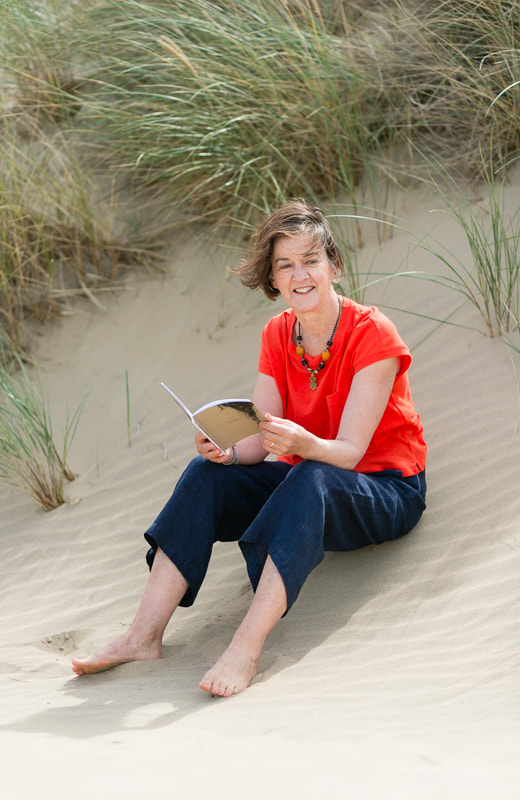
Caroline Fraser - an ordinary life
on life, suburban living, art, creativity, photography, book art and travel. Categories
All
Archives
July 2024
|


 RSS Feed